


Timber Cases & Wooden Cases: The Complete Buyer’s Guide
If you’ve searched “timber cases” or “wooden cases,” you’ve probably found a blog articles by timber packaging companies that all say the same three things: wood is strong, ISPM-15 matters for export, and you should “contact us for a quote.”
I bet none of them tell you how to actually decide what you need, what it should cost, or what goes wrong when people get it wrong.
This guide is written to close that gap. It covers the material science, the regulations, the real cost drivers, and the mistakes that cause rejected shipments or damaged freight — with straight answers, not sales copy.
What is a timber case?
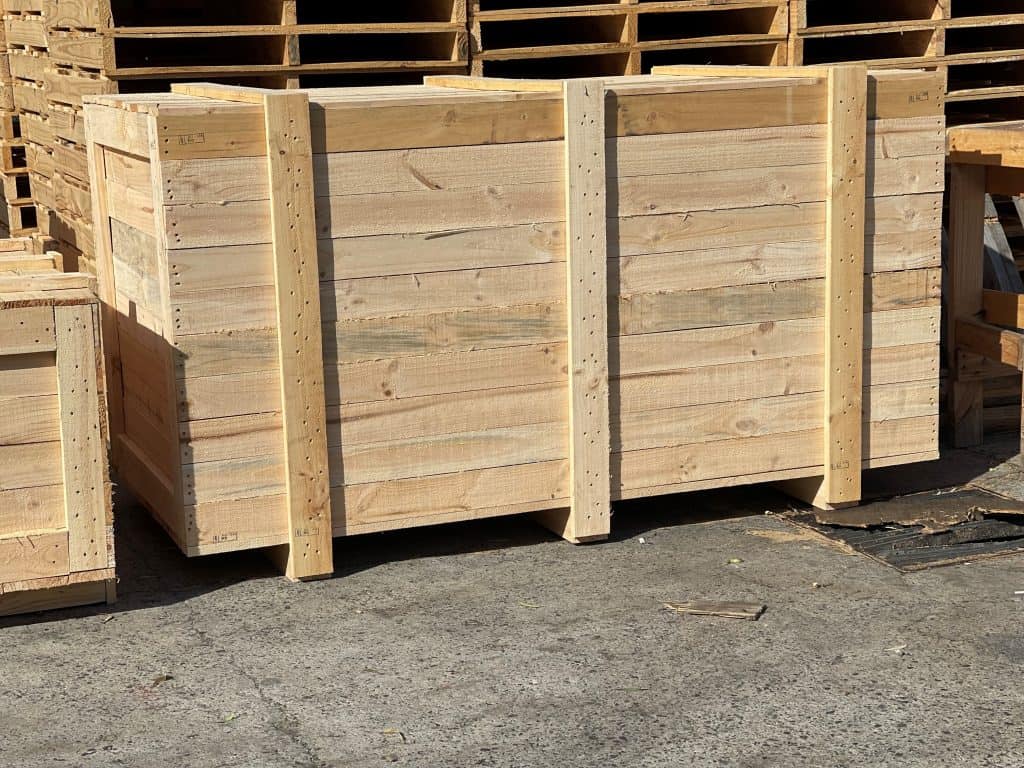
A timber case, also knows in the industry as a wooden case – is essentially a fully enclosed wooden shipping container — solid wood or plywood panels fixed to a timber frame, with a lid that closes the item in on all six sides.
Unlike an open pallet or a skeleton crate, a case fully encloses and protects its contents from dust, moisture, tampering, and impact during transport and handling.
Cases are typically used for:
- Machinery, tooling, and industrial equipment being exported or moved long distance
- Electronics, instruments, and anything sensitive to moisture or vibration
- High-value goods that need tamper-evidence (art, antiques, prototypes)
- Products going into rough handling environments — sea freight, multiple transfers, forklift and crane lifts
If your item just needs to sit on a base and be strapped down, you probably need a pallet or skid, not a case.
If it needs light protection for airfreight or trade shows, a plywood case is usually the better fit. Cases earn their cost when the contents are valuable, fragile, or the journey is long and unpredictable.
Timber case vs. crate vs. plywood case: what’s the actual difference?
These three terms get used interchangeably by suppliers, which is exactly why buyers get confused and overpay (or underspec).
Here’s the real distinction:
| Type | Construction | Best for | Typical weight range | Relative cost |
|---|---|---|---|---|
| Skeleton crate | Open timber frame, no full panelling | Bulky, sturdy items that can tolerate exposure (large machinery, engines) | 200 kg – several tonnes | Lowest |
| Timber case (solid/battened) | Fully enclosed, solid timber boards or ply-on-batten panels on a structural frame | Heavy, high-value, or sensitive equipment needing full enclosure and rigidity | 500 kg – 10,000+ kg | Highest |
| Plywood case | Plywood panels on a lighter batten frame | Airfreight, trade show equipment, electronics, mid-weight export goods | Up to ~500 kg | 30–50% less than solid timber cases |
The rule of thumb worth remembering: above roughly 500 kg (1,100 lb), or wherever crane/rigging lifts are involved, solid timber cases are the safer engineering choice.
Below that, plywood cases usually deliver the same protection for less weight and less cost — a genuinely useful distinction most competitor pages gloss over because they only sell one type.

What wood should your case actually be made from?
Not all “timber” is the same, and the material decision affects cost, weight, compliance, and sustainability.
Softwood (pine, spruce, fir). Fast-growing, cheap, and dominant in the industry — pine alone accounts for the large majority of packaging timber used worldwide.
It’s easy to work, light, and perfectly adequate for most general cargo. It’s less resistant to knocks and moisture than hardwood.
Hardwood (oak and similar species). Denser, more impact- and insect-resistant, and used where the case itself needs to survive rough, repeated handling or long-term outdoor storage. It costs more and adds weight, which matters for airfreight or weight-based freight charges.
Plywood (birch, softwood ply). Multiple thin veneers laminated with grain running in alternating directions, which gives plywood a strength-to-weight ratio that often beats solid timber of the same thickness. It also has smooth interior faces, so there’s no splinter risk against your product, and a much lower chance of splitting versus solid boards. Birch plywood is generally considered the more sustainable choice because birch regenerates quickly and the manufacturing process uses the tree efficiently.
Practical guidance: if weight and freight cost are the priority, specify plywood. If raw structural strength and abuse-resistance are the priority (repeated reuse, rough sites, long-term storage), specify solid timber, and consider hardwood battens with plywood panelling as a middle ground — you get most of the rigidity of solid wood with less weight than an all-solid-timber build.
ISPM-15: what it is and when you actually need it
This is the single most-searched question around timber cases, and it’s also where buyers get burned.
ISPM-15 (International Standards for Phytosanitary Measures No. 15) is the global rule, set by the International Plant Protection Convention, that governs solid wood packaging used in international trade — pallets, crates, dunnage, and timber cases. Its purpose is to stop timber pests (like wood-boring insects) from moving between countries inside packaging.
What it requires:
- The wood must be debarked.
- The wood must be heat-treated (56°C for a minimum of 30 minutes through the core) or, less commonly now, fumigated with methyl bromide.
- The finished item must carry the IPPC mark — often called the “wheat stamp” — showing the country code, producer/treatment facility number, and treatment method (HT or MB).
Who’s exempt: Wood-based products that have already been processed using heat or pressure/glue — plywood, OSB, particleboard, and similar engineered panels — are generally exempt from ISPM-15, because the manufacturing process itself kills pests. This is a genuinely useful fact for buyers: if your case is built entirely from plywood panels with no solid timber battens or framing, you may not need ISPM-15 treatment or marking at all. The moment solid wood framing over 6mm thick is introduced, ISPM-15 applies to that component.
What happens if you skip it: Customs authorities in the destination country can reject, fumigate on the spot, or in the worst cases destroy the entire shipment — contents included — if the wood packaging isn’t compliant. There’s no partial credit; missing or incorrect stamping is treated the same as no treatment at all.
A detail most guides miss: ISPM-15 covers the packaging, not the goods inside it. Compliant wood packaging around non-compliant goods doesn’t create a customs issue for the goods themselves — but non-compliant wood packaging around perfectly fine goods absolutely will hold up your shipment. Always confirm your supplier can show the treatment certificate for the specific batch of timber used, not just a general claim of “ISPM-15 compliant.”
How is weight capacity actually determined?
There’s no fixed weight limit for a timber case — capacity is an engineering outcome of four variables working together, not a single spec you can look up:
- Panel thickness and species — thicker, denser timber carries more load before flexing or failing.
- Frame and batten design — how the internal frame distributes weight to the base and corners.
- Base construction — skids, runners, or a full plywood floor change how weight is spread and how forklift tines interact with the load.
- Load distribution — a concentrated point load (e.g., one heavy component sitting on part of the base) needs local reinforcement even if the item’s total weight is otherwise unremarkable.
As a rough anchor: standard export cases comfortably handle loads from around 50 kg up to 1,000+ kg with standard designs, and custom-engineered cases are routinely built for machinery in the multiple-tonne range using thicker timber, cross-bracing, and steel-reinforced skids. If your item needs to be lifted by crane or slung with rigging (not just forklifted), say so upfront — this changes the structural design, not just the case’s price.
What actually drives the cost of a timber case?
Buyers are usually quoted a number with no breakdown. Here’s what’s actually in it:
- Size and weight of the goods — more material, more labor, more reinforcement for bigger and heavier items.
- Material choice — plywood vs. softwood vs. hardwood, and whether ISPM-15 heat treatment is required, changes the per-board-foot cost directly.
- Design complexity — irregular shapes, multiple components, internal dividers, or cradle/blocking systems for delicate items all add labor hours.
- Handling method — forklift-only designs are simplest; crane-lift or rigging-rated designs need calculated reinforcement and cost more.
- Environmental protection — moisture barriers, vapor-barrier bagging, desiccant, or waterproof coatings for sea freight or long-term outdoor storage add material and labor.
- Reusability — a one-way export case is priced differently from a returnable/reusable case built with hinges, latches, and heavier-duty joinery for multiple round trips.
Realistic range: simple standard cases for small-to-mid items typically run somewhere in the low hundreds of dollars; large, custom-engineered cases for heavy machinery with rigging-rated design and moisture protection can run well over a thousand dollars per unit. Anyone quoting you a number without asking about weight, handling method, and destination environment is guessing.
Reusable vs. one-way cases
This is a decision most buyers never explicitly make — they just get whatever the supplier defaults to.
One-way (export) cases are built to survive a single journey. They’re lighter, cheaper, and typically use butt joints and nails/staples rather than hardware designed for repeated opening.
Reusable/returnable cases use hinged lids, cam latches or bolts instead of nails, and heavier framing designed to survive dozens of open-close cycles and repeated freight handling. They cost more upfront but pay for themselves quickly if you’re shipping the same equipment repeatedly (trade show gear, service/field equipment, recurring machinery shipments between sites).
If you’re shipping the same type of item more than two or three times a year, it’s almost always worth asking your supplier for a reusable design quote alongside the one-way quote — the break-even point arrives faster than most buyers assume.
Sustainability: is timber packaging actually eco-friendly?
It depends entirely on sourcing, not the material itself.
- Plantation softwood (pine, radiata) used for packaging is fast-growing and renewable — some species reach usable size in well under a decade, compared to the many decades hardwoods need.
- FSC (Forest Stewardship Council) certification is the practical signal to look for: it confirms the timber came from a responsibly managed forest, not unregulated clearing.
- Plywood generally has a lighter environmental footprint per unit of strength than solid timber, because the manufacturing process uses more of each log and the fast-growing species typically used for ply (like birch) regenerate quickly.
- End of life matters more than people think. Timber cases are one of the few packaging formats that are genuinely reusable, repairable, and — at end of life — recyclable or compostable, unlike composite or foam-based alternatives. Ask your supplier whether they offer a take-back, buy-back, or timber-recycling arrangement; many regional suppliers do but don’t advertise it.
If sustainability reporting matters for your business, ask for the FSC chain-of-custody certificate and the treatment facility’s ISPM-15 registration number — both are usually available on request and cost nothing extra.

Common mistakes buyers make (and what they cost)
- Not specifying the handling method up front. A case designed for forklift-only use that then gets crane-lifted at the destination port is a real failure risk, not a hypothetical one.
- Assuming “wooden” automatically means ISPM-15-compliant. Only solid wood over 6mm needs treatment — but if your case does contain solid timber components, an untreated batten is enough to get the whole shipment held at customs.
- Underestimating internal bracing for irregular loads. A case rated for a given total weight can still fail if that weight sits on one unsupported corner — internal blocking and cradling matter as much as the external box.
- Choosing based on price per case, not cost per shipment. A cheaper one-way case that arrives damaged, or a plywood case used where solid timber was actually needed, costs more once you count damaged goods, delays, and re-shipment.
- Not asking about moisture protection for sea freight. Ocean transit involves weeks of humidity and temperature swings that airfreight doesn’t — a case spec that works for air can under-protect for sea.
Frequently asked questions
What’s the difference between a wooden case and a wooden crate? A case is fully enclosed on all six sides; a crate typically has an open or skeleton frame that doesn’t fully panel the item in. Cases give more protection from dust, moisture, and tampering; crates are lighter and cheaper for goods that can tolerate some exposure.
Do all wooden cases need ISPM-15 treatment? No. ISPM-15 applies to solid wood packaging materials — like solid timber boards, battens, and dunnage — over 6mm thick. Cases built entirely from plywood, OSB, or other manufactured wood panels are generally exempt because the manufacturing process already eliminates pest risk.
How much weight can a timber case hold? There’s no universal limit — it’s determined by panel thickness, timber species, frame design, and base construction. Standard cases handle roughly 50–1,000 kg; custom-engineered cases for machinery routinely exceed several tonnes with reinforced framing and steel-supported skids.
How long does it take to get a custom timber case made? This varies by supplier and complexity, but simple standard-size cases are often available from stock or within a few days, while fully custom-engineered cases (crane-rated, internal cradling, multi-component) commonly take one to three weeks depending on order volume and treatment/drying time for the timber.
Can timber cases be reused? Yes — reusable cases are specifically designed for it, with hinged lids and bolted or latched closures instead of nails. One-way export cases can sometimes survive a return trip but aren’t built for repeated cycles, so check with your supplier before reusing one that wasn’t designed for it.
Is plywood or solid timber better for export packaging? Neither is universally “better” — plywood is lighter and 30–50% cheaper for goods under roughly 500 kg, especially for airfreight and trade shows; solid timber is the stronger, more abuse-resistant choice above that weight or wherever crane/rigging handling is involved.
What information does a supplier need to quote accurately? Item dimensions and weight, handling method (forklift vs. crane/rigging), destination country and transport mode (air vs. sea vs. road), whether the case needs to be reusable, and any moisture or shock-sensitivity requirements. A quote given without this information is an estimate, not a real price.

